WESTERN COLORADO FRIENDS OF THE HIMALAYAS


This image, in the Everest region, was taken by Kelvin Kent on one his many treks to Nepal and used with his permission

Making a difference by supporting local communities in Nepal with humanitarian aid, literacy, educational and medical supplies, plus natural disaster relief and child trafficking mitigation
Our Mission is to foster peace by supporting the people of the Himalayan region in beneficial ways, help preserve the culture and provide opportunities for education, basic living necessities and medical resources, plus send aid during times of natural disasters.
Our motto is: PEACE : (Peace, education, aid, compassion, and empowerment)
We are based in Montrose, Colorado
Member of the Colorado Non Profit Association. Fed Id number: 30-0117036
Website: Himalayanfriends.com

As at November 2nd 2026. If you are visiting this website you will no doubt be aware of the terrible catastrophe that struck portions of Nepal on August 26th, A large avalanche and landslide of rock, ice and snow-riggered a collapse of a dam and glacial lake, close to the Tibetan border in the Langtang region. Over 50 million metric tons of material hurtled down 6000 feet of mountainside at 100 mph. This created as much energy as the Hiroshima atom bomb. Rivers downstream rose up to 70 feet, 37 bridges were obliterated or severely damaged, whole towns and villages were wiped out, nine hydro -electric power stations were destroyed and roads became severely damaged or undriveable. Latest stats show that 13,784 people have been rescued, 1,461 bodies have been recovered, 4,718 are still unaccounted for and 84,000 people have been displaced or made homeless, with 1,342 now located in 45 temporary holding shelters. (mainly schools holding up to 200 people) each. 15 schools have been completely destroyed and another 28 severely damaged. Countless students are without the means of receiving an education. Hundreds of young children are left without parents. Many of the reported deaths or missing are people who were undertaking religious pilgrimages near the Tibetan border. Over 600 foreign tourists from 69 countries are still missing and several hundred workers in the flooded tunnels connected with the hydro -electric plants are trapped. 45,000 acres of farmland is inundated and covered with many feet of mud. Livestock and pets have suffered tremendously. 62 miles of river and adjacent lands, properties, roads, power and infrastructure has been totally or partially destroyed and 1.6 million people have been indirectly affected. Damage is immense, with most assistance and supplies having to be flown in by helicopters. So far, 2,300 helicopter flights have been made. 21,000 Nepalese security personnel have been deployed plus Chinese, Indian and other foreign aid assistance. There is still no useable road for about 15 miles from Dunchhe Northwards. Several other road are completely washed out, thus restricting the move of essential supplies to many areas. Currently the emphasis is focussed on burying the dead, searching for survivors, DNA analysis, providing clean water and clothing, temporary shelter, medical aid, and toilet/shower facilities. Road and bridge building plus utility repairs is underway but will take a long time. Millions of tons of debris still need clearing and the available videos which show dark color or black fast- flowing rivers are, sadly, carrying away valuable top soil. Re-building of homes and businesses lost will take years. To exacerbate matters, Nepal has experiened an unusually heavy monsoon. With swollen rivers, landslides, additional flash flood damage and electric and cell phone outage in much of the country, another 26 deaths and several injuries have occurred with significant damage in the Gorkha region. Higher up, the monsoon has produced heavy, snow, resulting in multiple avalanches and the loss of dozens , if not hundreds of climbers, trekkers, guides, porters and pilgrims. In short, things are really bad in many areas.
Along with many international and other not-for-profits, we are stepping up with immediate financial assistance. Already, $11,000 has been sent and we are appealing, now, for more donations, with a goal of raising a further $10,000 to supplement our present funds so that we can further assess the needs and steer our contributions to specific entities that we trust to be honest, accountable and capable. Obviously, this need has to be addressed immediately. Our funds (apart from Shelter Box) are all going to our own partners on the ground and trusted individuals and smaller organizations, who operate with very low overhead.
Update as at early November 2026 with information derived from several credible sources. and with special acknowledgement and thanks to the British-Nepal Society.
Recovery from the main floods is progressing well. Emergency support and restoration of some key transport links has occurred but there remains a huge amount of work to be done to re-build homes, livlihoods and communities. The relief effort is now switching from rescue, evacuation and emergency distributions to restoring transport, providing temporary accommodation, family support and rehabilitation. Difficulty in accessing remote communities remains a major constraint and continuing outages of power and telecommunications in several areas are also inhibiting the recovery effort.
The good news is that 18 damaged suspension bridges along the Trisuli corridor have been repaired and returned to service. Some old-fashioned cable crossings have been repaired by locals and are now functioning again. Many roads have been re-built and are functioning but basic infrastructure is still lacking. Survivors need shops that can be re-supplied plus access to opportunities to work and make enough money to purchase basic goods. The Nepal government has ended search and rescue operations and accurate numbers for those affected are still not available. Estimates indicate that many thousands are still needing help for re-housing. This creates enormous emotional and practical problems. Addressing compensation, insurance and inheritance matters has faltered. One town alone called Betrawati in Rasuwa lost 193 inhabitants including several dozen childfen and was 80% destroyed.
Looking at the long term the Nepal government has established four priorities to start working on:
1. Rehousing displaced families, restoring homes where safe, indentifying new safer locations for re-building.
2. Restoring tranportation, essential services, bridges, roads, electricity, communications, drinking water and irrigation.
3. Reviving neighborhoods, agriculture, small businesses, tourism and employment for workers and lost income.
4. Plans for reducing future disaster risks, river management, debris removal, improved hazard warning monitoring and safe siting of houses, schools and public facilities. The key issue is fin ding the necessary resources required for such a comprehensive program of work. At least 8 billion dollars will be required. The Nepal PM's fund has generated about 100 million dollars and various nations are sending funds. However, the vast majority of what is needed remains unfunded. Acquiring loans will put a further strain on Nepal's Federal budget.
To donate, you can use our new DONATE BUTON to give by credit card or just send a check to: Western Colorado Friends of the Himalayas, PO Box 2022, Montrose, Colorado, 81402. All monies received will be acknowledged with a formal 501(c)3 receipt immediately and we pledge to use your contribution wisely and effectively.
If you have any questions, or if you would prefer to send a donation from your bank, I will be pleased to answer them.
Kelvin Kent (board member) 970 209 1395.
Note: Even though our current focus is on helping out with funding for the flood relief, we remain committed to supporting the many other causes that we help and continue to assist. (See gallery and projects).

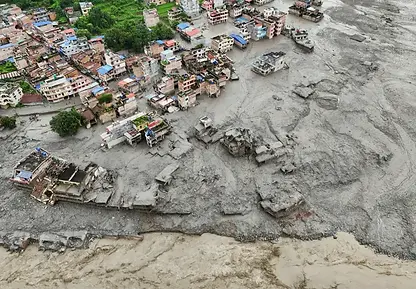


The above images give you an idea of the scale of disaster.


Mr Chandra Bahadur Khatri with is team. Note the Western Colorado Friends of the Himalayas banners!


In 2015, Sherpa mountaineering icon Pasang Lhamu Sherpa Akita (National Geographic Adventurer of the year and one of our valued partners), swung into action with a huge amount of help for the devastating earthquake. Now, in 2026 she and her organization are assisting once again.

Mr Chandra Bahadur Khatri is chairman of the Kathmandu based Disabled Center.
Like all of his clients, he, too, is disabled and wheelchair bound. In September, he and a partner (who is a Buddhist monk called called Kunga), plus a Sherpa lady called Sita, formed a small organization (not a component of the Disabled Center, which we support serately), pecifically to help flood victims in the Dhading area holding camp. They immediately decided to help 40 children with study tables, metal storage containers, electrical extension cords, phone charging equipment, light bulbs, and other necessities.To get all of this there, Chandra and his team hired large vehicles and attended to many other needs. However, the idea was so popular and well received that family members have now also requested the same treatment. We are immenslely impressed with the efficiency and tangible assistance that Chandra and his team are doing that we have sent them $6000 so far.
So successful was this program that Chandra Bahadur's team want to
do the same thing in Trishuli and Nawakot aeas; both extremely hard hit by the floods.
Please help us to alleviate the damage and terrible consequences that families, especially orphans and young children, are now faced with.

Each family has their own lockable
storage box

Click on a video below, make sure to turn the volume up. When you are done watching it, go to the top of Facebook and click on the X to get out of it and you will come back here to watch another video.


